
On this page you will find guidance to help families to keep themselves and their children active and healthy.
On this page
- Keeping physically active
- Early Movers
- Respiratory illness
- Should I keep my child off school
- Smoke free families
- Asthma
- Health for kids
- Health for teens
- Sexual Health and Relationships
Keeping physically active
Regular exercise is important for a healther happier life. As much active play as possible in children under 5 is encouraged, and older children are recommended to be active for an average of 60 minutes a day across the week. The UK Government has produced a series of physical activity guidelines infographics (Gov.uk) which explain the physical activity needed for general health benefits at different stages in life. The overall message is: any activity is better than none, and more is better still.
The guidance advises on safe levels of activity for pregnant women and new mothers, and the many benefits that this can bring as long as they listen to their body and speak to their health professional. A moderate amount of exercise for new mothers is proven to help them:
- regain strength
- ease back pain
- reduce the risk of gestational diabetes
Advice is also available to encourage good development in babies and children, with the UK Chief Medical Officers recommending lots of ‘tummy time’.
Learn why children need exercise and the importance of keeping active in this 3-minute video Movement is Life, produced by ForMed flims.

Early Movers
Early Movers is a free resource designed to promote physical activity and physical development opportunities for children under the age of 5, by providing useful information and activity suggestions which can be used in early years settings.
The website has been designed alongside early years practitioners to help you understand and feel confident in providing physical development (PD) opportunities to children in your setting or at home.
Further information can be found at Helping under 5s live active and healthy lives (Early Movers website)
Respiratory illness - difficulty breathing and wheezing
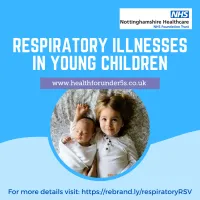
Respiratory illnesses are conditions that affect the lungs and airways, if you think your child has a respiratory illness find out what to look out for and what to do by visiting Respiratory illnesses in young children (Nottinghamshire Health for Under5s)
Find out more about symptoms and when you should worry in this article Difficulty breathing (Healthier Together.nhs.uk)
Should I Keep my Child off School?
Yes, you should keep your child off school if they have any of the following:
- Chickenpox - Until at least 5 days from the onset of the rash and until all blisters have crusted over
- Diarrhoea and Vomiting - Until 48 hours after their last episode
- Cold and Flu-like illness (including COVID-19) - Until they no longer have a high temperature and feel well enough to attend. Follow the national guidance if they’ve tested positive for COVID-19
Find out more at COVID-19 symptoms and what to do (NHS)
- Impetigo - Until their sores have crusted and healed, or 48 hours after they started antibiotics
- Measles - Until 4 days after the rash first appeared
- Mumps - Until 5 days after the swelling started
- Scabies - Until they have had their first treatment
- Scarlet Fever - Until 24 hours after they started taking antibiotics
- Whooping Cough - Until 48 hours after they started taking antibiotics
No, you do not need to keep your child off school if they have any of the following, but make sure you let their school or nursery know about:
- Hand, foot and mouth
- Glandular fever
- Head lice
- Tonsillitis
- Threadworms
- Slapped cheek
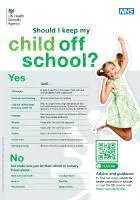
This handy guide Should I Keep my Child off School? [PDF] produced by NHS is great to refer too
For more information read the Health protection in children and young people settings, including education - GOV.UK guidance
Smoke free families
Passive smoking is especially harmful for children as they have less well-developed airways, lungs and immune systems. Children who live in a household where at least 1 person smokes are more likely to develop:
- asthma
- chest infections – like pneumonia and bronchitis
- meningitis
- Ear infections
- coughs and colds
Children are particularly vulnerable in the family car where second-hand smoke can reach hazardous levels even with the windows open.
Learn how second hand smoke can affect your children in this 1-minute video produced by Fresh.
Is it ever ok for you to smoke indoors?
With the window open?
When the kids are at school all day?
Even with the window open...
Your invisible second hand smoke lingers for up to five hours.
Waiting for your kids to breathe it in.
For your kids' sake never smoke indoors.
For tips, advice and support visit FreshQuit.co.uk
Find further information at Smoke Free Families Smokefree families (Fresh)
Asthma
Why should You learn more about asthma in children?
- Around 1 in 11 children and young people live with asthma (that’s roughly 3 in every classroom)
- Children can die from asthma
- UK has one of the highest emergency admissions and death rates for childhood asthma in Europe
- Education about asthma will give accurate information and guidance to reduce risks
There is now free online training available for you to learn more about asthma in children and young people. It only takes 45 minutes to complete and can be
revisited and completed at your own pace. This nationally recognised resource has been developed by expert NHS health professionals in consultation with parents, teachers, nursery workers, sports
coaches, and children’s activity leaders. Anyone who uses the resource will gain
the knowledge and confidence to support children and young people with asthma, deal with emergency situations and could help save lives
You can register and access the training at Supporting Children's Health and Young People with Asthma (Education for health)
Health for Kids!
Find top tips and advice on all aspects of children’s emotional and physical health, from keeping kids active and eating well, to building their confidence and equipping them to cope with specific health issues.The website features interactive content, films and quizzes written by health experts and includes topics as wide ranging as exam stress to anger management, and from spots to alcohol.
Further information can be found at www.healthforkids.co.uk
Health for Teens

The Health for Teens website supports young people aged 11 - 19 with their health and wellbeing. The website features interactive content, films and quizzes written by health experts and includes topics as wide ranging as exam stress to anger management, and from spots to alcohol.
Health for Teens also links young people to appropriate local health and wellbeing services, supporting young people to manage their health and wellbeing.
The main sections of the website are:
- Feelings
- Growing Up
- Health
- Lifestyle
- Relationships
- Sexual Health
Further information can be found at www.healthforteens.co.uk
Sexual Health and Relationships
C Card
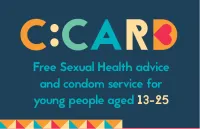
The C Card Scheme is a free sexual health advice and condom service for young people aged 13-25 living in Nottinghamshire.
The C Card scheme allows young people to get access to condoms, lubricants and ask any questions they have about sex, sexually transmitted infections and relationships.
You don't have to be having sex to use this service; the advice is free and confidential and is aimed at helping young people make the right choice about sexual health.
Further information visit C:Card Nottinghamshire.
SEXions
SEXions is a confidential sexual health service for young people aged 13-19, and up to 24 for young people with disabilities. SEXions offers community drop in centres that young people can access for:
- chlamydia testing
- pregnancy testing
- advice & support
- C-Card services
They offer one-to-one support and advice surrounding all aspects of sexual health including sexually transmitted infections, contraception, healthy relationships, online safety and access to other sexual health services.
Young People can refer themselves into the service, as can other organisations on behalf of the young person.
Further information can be found at SEXions (NHS)