

Find out things you, your partner and family can do, to help grow your child’s language and communication skills
On this page
- What your baby can do
- How can you help
- What you can do
- What to do if you need advice
- Start Talking together leaflet
What your baby can do
At 0 to 6 months, your baby can
- Use different cries to express their feelings
- Recognise familiar voices
- Respond to loud noises like a door slamming
- Stick out their tongue and move their lips when you speak to them
- Smile at around 5 to 6 weeks
- Laugh at about 3 months
- Make cooing noises at around 3 months
- Show a real interest in your face
Language for life
Language for Life Talking Together, Ages and Stages booklets from Nottinghamshire Healthcare trust can help you to understand what stage your baby is at in their development.
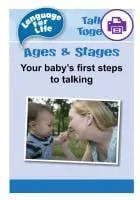
Language for Life Talking Together Your baby's first steps to talking [PDF]
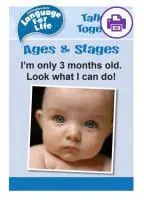
Language for Life Talking Together I'm only 3 months old look what I can do [PDF]
Further booklets can be found at Language for Life - Look what I can do (NHS Nottinghamshire Healthcare Trust)
Speaking more than one language
If you speak more than one language at home, it's important to talk to your child in the language, or languages, you feel most confident speaking.
Children who speak more than one language babble and say their first words in the same way as children learning one language, but some may do it slightly later. It is important not to confuse this slight delay with language difficulties – most children quickly catch up.
Nottinghamshire Healthcare Trust have useful information about bilingualism. They have produced the Language for Life Talking Together, Maintaining Your Child’s First Language booklet in English, Polish, Arabic, Romanian and Urdu
To find out more, visit Bilingualism (NHS Nottinghamshire Healthcare Trust)
How can you help
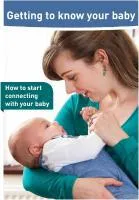
Getting to know your baby
The 'Getting to know your baby leaflet' provides new mums with some suggestions on how you can start connecting with your baby. From talking to your bump, skin to skin contact and talking to your baby from day one.
Download Getting to know your baby leaflet (HSC Public Health Agency)
Videos on getting to know your baby can be found on The Institute of Health Visiting (IHV) website.
Visit: Getting to know your baby (IHV)
Family Hubs
Family Hubs are great places for families with new babies, offering lots of support, such as the under one's stay and play session which is open to everyone, so they’re an excellent place for you to meet other families with young babies in your local area and make friends.
In Nottinghamshire we have
- New Parents groups
- Baby Massage Sessions
- Baby Little Talkers groups
- BABES support groups for mums who choose to breastfeed their babies
- Baby Incredible Years groups
- PHEW groups (Parent Health & Emotional Wellbeing)
- PEEP Groups What is PEEP? Two Minute Guide (People Learning Together YouTube video)
Find your nearest Family Hub (Nottinghamshire County Council)
Speech and Language UK
The children’s communication charity Speech and Language UK provide support to parents and carers, and practitioners in helping children develop their speech, language and communication skills. Use their online Progress Checker to see how your child is getting on with their speech, language and communication development.
Find this and more free resources and services on their Help for families webpage
Best Start in Life
Best Start in Life, has trusted NHS health advice and guidance for parents and as is the new home of Start for Life. Find the advice on supporting your toddler's development, Baby's first sounds: 0 to 6 months (Best Start in Life - NHS)
What you can do
There are lots of opportunities in the community and at home to help your baby's language development. Here are a few ideas that are low cost, no cost to try.
Inspire Libraries in Nottinghamshire
Our friends at Inspire have lots of family learning and activity sessions, which are a great way to support your little one’s speech, language and communication.
Rattle, Rhyme and Roll sessions for babies and toddlers are held at many libraries. These free sessions last about 30 minutes. Find your closest Rattle, Rhyme and Roll sessions (Inspire Libraries)
Story Hullaballoo sessions are for children under the age of five and include stories, songs and rhymes. These free sessions last about 30 minutes. Find your closet Story Hullaballoo sessions (Inspire Libraries)
To find out about other family learning sessions Inspire offers, go to Children and Families - (Inspire Libraries)
A Bookstart pack, with a free book and ideas on sharing stories with children, is available from your Healthy Families Team practitioner (health visitor) or when you register as a library member with Inspire Libraries.
There are Bookstart packs available from Inspire Libraries that are aimed at children aged 0 – 5 with additional needs.
For more details visit Bookstart Packs (Inspire Culture, Learning, Libraries)

BookTrust
BookTrust is the charity behind Bookstart, they have lots of ideas for fun things to do as a family.
Visit: Supporting Parents, Carers and Families (BookTrust)
Words for Life
The National Literacy Trust have fun activities for newborns to 6-months old to help practise language and communication skills on their Activities for 0-6 months (Words for Life)
Download free Little Moments Together cards. These give you tips on chatting with your child during everyday moments together.
Look Say Sing Play
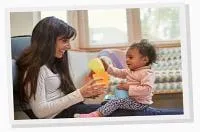
Right from birth, every time you talk, sing or play with your baby, you're not just bonding, you're building their brain.
NSPCC have some fun and easy tips to help you bring even more enjoyment into your daily routines. Aimed at parents and carers of children under the age of two.
You can also sign up to receive new tips, tailored to your child's age, each week.
Go to Look, Say Sing, Play,
Singing
Singing rhymes is one of the easiest ways you can support your child's speech.
'Sing songs and rhymes with me' is a great little booklet of nursery rhymes produced by the Speech, Language and Communication Service at NHS Nottinghamshire Healthcare Trust.
Download Language for Life-Sing songs and rhymes with me [PDF]
For lots of top tips and advice, go to How you can help your child?-(NHS Nottinghamshire Healthcare Trust)
You can join in with some Songs and rhymes videos (NHS Nottinghamshire Healthcare Trust)
For more great ideas, go to
- Singing nursery rhyme lyrics with babies and children (Words for Life)
- Sing With Piccolo Activity Ideas (World Nursery Rhyme Week)

CBeebies Parenting
Discover some activities to help with early communication and listening skills:
- Tips and advice for children's speech and language (CBeebies Tiny Happy People)
- Activities for 0 to 3 month olds (CBeebies Parenting)
- Activities for babies 3 to 6 months (CBeebies Parenting)
Things to do at Home
We've gathered together more ideas on communicating with your baby, and activities you can try at home on our Things to do at home: 0 to 6 months page.
What to do if you need advice
You may be concerned if your baby is not responding to sound or to your voice. At around 6 months, your baby may
- respond to familiar voices, turn when they hear their own name and ‘take turns’ in conversations with babbling
- use speech sounds (babbling) to communicate with adults
- be startled by loud noises
- engage in eye contact when spoken to
- smile back at someone smiling at them
- watch a speaker’s face with interest
Source: Development Matters 2021
If you are concerned, contact one of the services below:
Nottinghamshire's Healthy Family Team
Telephone: 0300 123 5436
Find out more, go to Healthy Family Teams (Directory Listing)
For parents and carers of children aged 0 to 19 years and for young people aged 16 to 19.
Nottinghamshire Healthcare Speech and Language Advice Line
Telephone:0300 123 3387 OPTION 1
Nottinghamshire and Nottingham City (except Bassetlaw)
Opening times:
Monday and Tuesday 9.30am to 4.30pm
Wednesday, Thursday and Friday 9am to 12.30pm
Your GP
Start Talking together leaflet
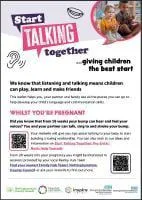
Our Start Talking together leaflet give lots of top tips on how you and your family can help develop your little one’s talking. We hope you find it useful.
Download the Start Talking together leaflet [PDF]