

Find out things you, your partner and family can do, to help grow your child’s language and communication skills
On this page
- What you baby can do
- How can you help
- Home Talk
- What you can do
- What to do if you need advice
- Start Talking together leaflet
What your baby can do
At 2 to 3 years your child can
- Understand around 100 words and simple instructions for example, ‘get your shoes’
- Use about 50 words. These won’t sound like real words because your child will mainly be using sounds like ‘p’, ‘b’, ‘m’ and ‘n’
- Echo words they hear
- Put words together to make little sentences for example, ‘more drink’
- Use up to two sequences in their play for example, wash dolly then brush hair
- Understand longer instructions of up to 2 key words for example, ‘get a biscuit and your cup’
Language for life
Language for Life Talking Together, Ages and Stages booklets from Nottinghamshire Healthcare trust can help you to understand what stage your baby is at in their development.
![Ages and Stages I'm 2 and a half [Printable]](/image-library/content/imported/a-s-2-and-a-half-years-print-display.x54fa9d2a.jpg?h=200&w=144&f=webp&fit=crop&q=80)
Language for Life Talking Together I'm 2 and a half! [PDF]
Nottinghamshire Healthcare provides advice for parents, families and professionals in Nottinghamshire to help children learn to talk and communicate. You can find information on things you can do to support your child's speaking and listening skills, support services that are available and resources for professionals at Language for Life (Nottinghamshire Healthcare)
Further booklets can be found at Language for Life - Look what I can do (NHS Nottinghamshire Healthcare Trust)
Speaking more than one language
If you speak more than one language at home it's important to talk to your child in the language, or languages, you feel most confident speaking.
Children who speak more than one language babble and say their first words in the same way as children learning one language, but some may do it slightly later. It is important not to confuse this slight delay with language difficulties – most children quickly catch up.
Notts Healthcare Trust have useful information about bilingualism. They have produced the Language for Life Talking Together, Maintaining Your Child’s First Language booklet in English, Polish, Arabic, Romanian and Urdu
To find out more, visit Bilingualism (NHS Nottinghamshire Healthcare Trust)
How can you help
Family Hubs
Nottinghamshire Family Hubs are great places for families with new babies, offering lots of support, such as the under one's stay and play session which is open to everyone, so they’re an excellent place for you to meet other families with young babies in your local area and make friends.
We also have
- New Parents groups
- Baby Massage Sessions
- Baby Little Talkers groups
- BABES support groups for mums who choose to breastfeed their babies
- Baby Incredible Years groups
- PHEW groups (Parent Health & Emotional Wellbeing)
- PEEP Groups What is PEEP? Two Minute Guide (People Learning Together YouTube video)
Contact your local Family Hub:
Find your nearest Family Hub (Nottinghamshire County Council)
Family Hubs Get Talking
Nottinghamshire Family Hubs have produced a little booklet which provides some simple suggestions for parents on how to support your child's speech and language development in the early years. With helpful sentence starters and other ideas to use at different ages of their development.
Download the Get Talking Booklet (Nottinghamshire Family Hubs) [PDF]
Get Talking!
Speech, language, and communication are a vital part of your child’s early development. The skills they learn now will help them throughout their lives being able to hold conversations, communicate basic needs, feelings, thinking, problem solving, building relationships and so much more.
Chances are you might be supporting your child’s language skills without even realising. Singing songs, reading, and telling stories that have rhythm and repetition can all help your child to learn and remember words.
If you speak more than one language at home, then talk with your child in the language that you feel most confident using.
Hit the pause button
Children need time to process what is being asked of them. It can sometimes take your child up to 10 seconds to hear what you are saying, to process it, to let their brain put the words in order, and think about how to sound the words out to reply to you. When you ask a question or make a comment while you are playing and chatting together, try hitting that imaginary pause button and count to 10 in your head before saying anything else.
Helping our children develop their language skills shouldn’t feel like we are always questioning and testing them to find out what they know. Point things out while you are out and about and while you are doing those routine, everyday jobs. Make comments that get your child thinking…
'hmm, I wonder what that could be for…' and 'what do you think?'
As their confidence and skills grow you might find yourself being led on a wonderfully fantastical journey of imagination, story-telling, and lateral thinking.
You could try some of these sentence starters when you are talking and playing together. They will help your child to stretch their thinking, to problem solve, to make predictions and to evaluate. Enjoy being carried along as the conversation takes all kinds of directions through their thoughts and logic. And don’t forget to hit that pause button
- What do you think would happen if…?
- What do you think will happen next?
- What can you tell me about…?
- Tell me more about…
- Can you think of another way?
- What could you do or use instead?
- What else could it be used for?
- I wonder why…
The Department of Education have produced a guide for parents which covers the seven areas of learning and development in a child's early years.
To read the guide in full visit What to expect in the Early Years Foundation stage A guide for parents (The Department of Education)
Here are a few other ideas taken from it:
Birth to 3 years old
- Sing songs and rhymes while changing nappies and during other everyday activities
- As your child picks up things to explore say the name of the object
- Repeat and build on what your child says by adding one or two words
- Give 10 seconds to allow your child time to process, understand and think of a reply
3 – 4 year olds
- Use your body language. Encourage your child to talk by nodding, smiling, and making comments
- Introduce new words while doing everyday jobs, when you are playing together, at mealtimes, or while you are out and about
- Talk about things that have already happened, and what might happen soon
- Play listening games like ‘Simon Says...’
4 -5 year olds
- Treasure hunts - give your child instructions, directions, or clues that they have to listen carefully to.
- Talk out loud about what you are doing and what your child is doing
Home Talk
We know that lots of parents worry about their child’s speech, language and communication skills. Working closely with the Healthy Families Team, the Family Hubs are able to support young children aged 2 to 2 and a half years through the Home Talk programme (delivered by Nottinghamshire Healthcare NHS Foundation Trust).
Find out what you can expect from the Home Talk programme, in this 3-mintue YouTube video
Home Talk is a 6 week programme delivered in your family home, with a trained Home Talk worker, who will support you and your child to develop a language rich learning environment at home.
What do parents say about Home Talk?
"Home Talk has completely changed our lives...before the Home Talk Worker (HTW) came to help my child with her speech, my child suffered from lots of tantrums - constantly, she couldn't communicate her needs and I couldn't understand her. It left us both feeling upset....l felt completely defeated as a mother to the point where I was finding it difficult to leave the house... Additionally my child struggled with her relationship with her younger sibling...and...my husband. Home Talk has honestly been a miracle...My child's speech has improved so much that she now is able to talk to us...With this her tantrums have stopped, she is so close to her sister and my husband. Our home is just so much happier and together...The Home Talk Worker really saved us!"
For more information on Home Talk programme, you can visit
To be referred to the Home Talk Service, if your child attends an early years setting, please speak to your child’s key worker or please speak to your Healthy Families Team
Early Learning and Childcare
Sending your child to an early learning setting really helps them to develop their speech, language and social skills and is a great step towards getting ready to start school.
Working families with children from 9 months can receive funding towards childcare costs and some families in receipt of certain government support can receive funding when their child is 2 years old. All children receive funding when they are 3 years old. To find out more go to Help with Childcare Costs
Learn how 2 year old funded places have worked for this parent of a 2 year old in this 30-second Youtube video
Speech and Language UK
The children’s communication charity Speech and Language UK provide support to parents and carers, and practitioners in helping children develop their speech, language and communication skills. Use their online Progress Checker to see how your child is getting on with their speech, language and communication development.
Find this and more free resources and services on their Help for families webpage
What you can do
There are lots of opportunities in the community and at home to help your baby's language development. Here are a few ideas that are low cost, no cost to try.
Inspire Libraries
Our friends at Inspire have lots of family learning and activity sessions, which are a great way to support your little one’s speech, language and communication.
Rattle, Rhyme and Roll sessions for babies and toddlers are held at many libraries. These free sessions last about 30 minutes. Find your closest Rattle, Rhyme and Roll sessions (Inspire Libraries)
Story Hullaballoo sessions are for children under the age of five and include stories, songs and rhymes. These free sessions last about 30 minutes. Find your closet Story Hullaballoo sessions (Inspire Libraries)
To find out about other family learning sessions Inspire offers, go to Children and Families - (Inspire Libraries)
A Bookstart pack, is available from your Healthy Families Team practitioner (health visitor) or when you register as a library member with Inspire Libraries.
Children aged 0 – 5 with additional needs can receive a second Bookstart pack as well.
Visit Bookstart Packs (Inspire Culture, Learning, Libraries)

BookTrust
BookTrust is the charity behind Bookstart, they have lots of ideas for fun things to do as a family.
Visit: Supporting Parents, Carers and Families (BookTrust)
Words for Life
The National Literacy Trust have fun activities for one to two years old to help practise language and communication skills on their:
The National Literacy Trust have produced a Chat, Play, Read Activity Booklet free to download. Filled with fun and simple activities to support your child to learn new words and develop their language and communication skills. It is also available in different langauages.
Find out more and download Chat, Play, Read activity booklet (Words for Life)
Look Say Sing Play
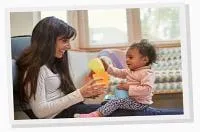
Right from birth, every time you talk, sing or play with your baby, you're not just bonding, you're building their brain.
NSPCC have some fun and easy tips to help you bring even more enjoyment into your daily routines. Aimed at parents and carers of children under the age of two.
You can also sign up to receive new tips, tailored to your child's age, each week.
Go to Look, Say Sing, Play
Best Start in Life
Find idea for children aged 2 to 3 years on Chatting and building sentences (Best Start in Life)
Cbeebies Parenting
Discover some activities to help with early communication and listening skills:
- Tips and advice for children's speech and language (CBeebies - Tiny Happy People)
- Activities for 2 to 3 years olds (CBeebies Parenting)
Things to do at Home
We've gathered together more ideas on communicating with your baby, and activities you can try at home on our Things to do at home: 2 to 3 years old page.
What to do if you need advice
From around 3 years old, your child may
- be able to shift focus from one task to another, if you get their attention. Using the child’s name can help: “Jason, please can you stop now? We’re tidying up”.
- use around 300 words, including descriptive language. Which may include words for time, space fand function, for example:
- start to link up to 5 words together
- use pronouns, ‘me’, ‘him’, ‘she’, and using plurals and prepositions, ‘in’, ‘on’, ‘under’, these may not always be used correctly to start with.
- follow instructions with three key words like: “Can you wash dolly’s face?”
- show that they understand action words by pointing to the right picture in a book. For example, “Who’s jumping?”
Watch out for children whose speech is not easily understood by unfamiliar adults, consider if they might need a hearing test.
Source: Development Matters 2021
Where to get advice
If your child goes to a childminder, pre-school playgroup or day nursery do speak to your child’s key worker. They may well have noticed that your child needs some help with communication and will have some ideas of things that will help.
If you feel your child is not responding to sound or to your voice please contact one of the below services.
Nottinghamshire's Healthy Family Team
Telephone: 0300 123 5436
Find out more, go to Healthy Family Teams (Directory Listing)
Nottinghamshire Healthcare Speech and Language Advice Line
For parents and carers of children aged 0 to 19 years and for young people aged 16 to 19.
Call: 0300 123 3387 OPTION 1
Nottinghamshire and Nottingham City (except Bassetlaw)
Monday and Tuesday 9.30am to 4.30pm
Wednesday, Thursday and Friday 9am to 12.30pm
Talking and communication drop ins
Come along to one of our early years drop-in sessions for children under 4 years old if you'd like to talk with us about your child's talking and communication.
No need to book! Just pick a date and come along with your child at any time during the session.
Your GP
Start Talking together leaflet
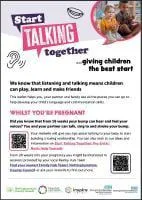
Our Start Talking together leaflet give lots of top tips on how you and your family can help develop your little one’s talking. We hope you find it useful.
Download the Start Talking together leaflet [PDF]