

These activities can help you think about your relationship with your partner (or parent of your child) and includes tips on how to resolve arguments or conflict in a healthy way.
On this page
- Stages of a relationship
- The Relationship Scale
- Impact of thoughts, feelings and behaviours on relationships
- Self-care: What about me?
- Time as a couple
- Family time
- Who else can help
- Types of conflict in a relationship
- How arguments work
- Top tips: What to try for and what to avoid in arguments
- More on improving relationships
Stages of a relationship
Relationships usually develop in six stages over time, like moving up a staircase.
The six stages are:
- Romance
- Reality
- Power struggle
- Finding yourself
- Acceptance
- Respect and understanding
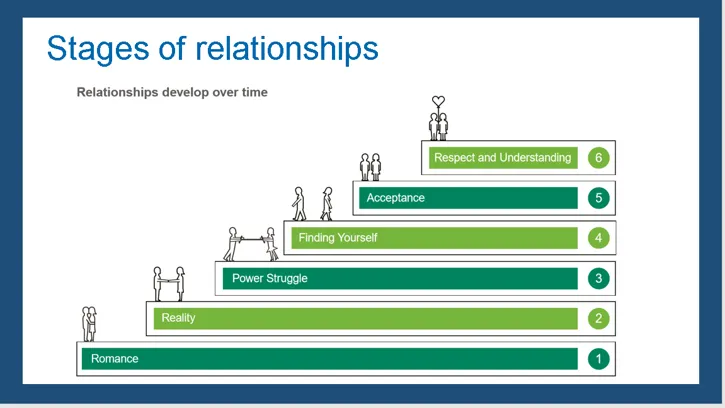
What to do: Find out what stage your relationship is in
Considering these stages, ask yourselves the following questions:
- Where do you see your relationship on the staircase? Why?
- Where would your partner see themselves on the relationship staircase? Why?
- Are you both at the same stage?
- Are you happy where you are on the staircase?
- What could you do to help you to get to the next step?
- How will you know that you have reached this?
- Do you need help to achieve this?
To learn more, download Getting on Better: Stages and changes of relationships (One Plus One) [PDF]
The Relationship Scale
Imagine a relationship is like a scale. At one end is happy, where you want to be. At the other end is distressed, what you should try to avoid.
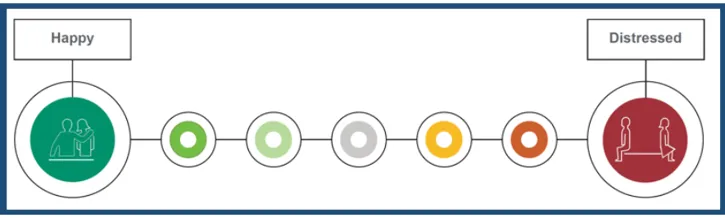
What to do: Find out where you are on the Relationship Scale
We’d all like to be happy, in the green area, wouldn’t we? If you are not where you want to be, how can we change this?
Think about where you are on the scale. Use the following questions to help you think about where you are now and where you'd like to be.
- How would things look if it were better?
- What would be happening?
- What would have to change?
- What would you or your partner be doing differently?
- What would you be thinking and feeling?
- What might get in the way?
- Who has helped you to make up before?
Impact of thoughts, feelings and behaviours on relationships
How we interpret things, what we think and feel impact our own behaviours and can impact our relationships with others.
What to do: Think about your thoughts, feelings and behaviours
How many times have you thought, "We just don't understand each other."
Think about a behaviour you observed with your partner and what it made you think, feel and do and complete the following statements:
- Behaviour observed: I see...
- Thoughts: I think…
- Feelings: I feel…
- Behaviour: I behave by…
For example:
- Behaviour observed: "I see you watching the football and ignoring me.'
- Thoughts: "I think this means you don't want to be around me.'
- Feelings: "This makes me feel unloved.'
- Behaviour: "I slam doors in the kitchen to let you know I am not happy!"
Share your answers with your partner. You may be surprised at what they’ve written. This could help you understand them a little better in the future.
Self-care: What about me?
It’s important for us all to have a little “me time” in our busy lives. When you’ve got children, it’s tricky to fit in.
What to do: Think about how to take care of you
When thinking about how to take care of you, ask yourself:
- What do you do to relax?
- How often do you get time of your own?
- What would you like more time for?
- How could your partner help with this?
Write down what you’d like to do to look after yourself. It doesn't have to be big like a weekend at a spa or going to all the away games of your football team.
Think about little things that are easier to achieve, like as having a soak in a warm bubble bath once a week or getting to play football with your friends on a Saturday afternoon.
There’s more chance of being able to do this. There's also more chance that your partner can support you to have more time to focus on yourself.
Time as a couple
Before you were a family, you were a couple. It’s important to spend a little time on the two of you.
What to do: Spend time together as a couple
It can be easy to just focus on the challenges of day to day family life. Think about these questions and work out a plan on how you could fit more time in for each other.
When thinking about spending time together, ask yourself:
- Who could have the children to help you do this?
- How could you make this happen more often?
- When did you last fit this in?
- What activities do you enjoy doing as a couple?
Family time
It's important for children that they get to spend time with their parents as a family.
What to do: Make time for family
Have a chat with your partner and see if you can come up with a plan. Don’t forget to ask the kids when thinking about what you like to do as a family.
Make sure to keep it simple and real, not a wish list that's hard to make happen.
When thinking about family time, ask yourself:
- What do you enjoy doing as a family?
- How often do you mange this?
- What would help you to do this more often?
Who else can help?
You can’t always go it alone. We all need a bit of help sometimes.
What to do: Find a support network
Ask yourself who you can rely on when you need support. Try and find a support network that can help when you need it.
Types of conflict in a relationship
Their are two types of conflict that can impact family relationships, constructive conflict and destructive conflict.
Constructive conflict:
- is less intense, is resolved and is less frequent
- allows children to benefit from seeing the parents resolve their differences and disagreements
- teaches valuable lessons about compromise, negotiation, resolving differences and reaching agreements.
Destructive conflict:
- presents as frequent, intense and poorly resolved
- can occur in all family structures and when parents are together or separated
- puts children exposed at risk of poor social, emotional and educational outcomes as well as physical, emotional and mental health
- can impact on a child's ability to form and sustain positive, healthy relationships as well as future romantic relationships.
It's important for children that parents are able to argue in a constructive and positive way.
Conflict during parental separation or divorce
Research shows levels of conflict and arguing between parents before and during a relationship breakdown, not the event of separation or divorce, is key in explaining why some children fare better than others.
Why it's important for children that you get along together
Children are like sponges, they absorb what's going on around them - the feelings, the noise, what they see.
When parents argue in a destructive way, many children:
- internalise emotions such as sadness, withdrawn, anxious, depressed
- externalise emotions such as aggression, having behaviour problems or acting out
- feel like they have to provide parents with emotional support, make excuses or have to care for siblings.
Resolving your arguments constructively will mean your child will:
- be happier
- worry less
- sleep better
- be more resilient
- feel more secure and stable
- have better and more trusting relationships
- learn how to manage conflict
- learn how to resolve arguments
- have a better focus at nursery or school
- be more confident.
What to do: Think about how children feel when parents argue
How do you feel when you have an argument with your partner? How do you think your child might feel?
Do the following:
- Write down a few words or draw a picture that shows how you feel when you and your partner or ex-partner argue.
- Draw another one or jot down a few words about how this might make your child feel.
How arguments work
When you know how arguments work, you can learn to keep them under control. There are many things that can trigger an argument.
- Money or finances
- Parenting style
- Division of household tasks
- Extended family relationships (in-laws)
- Work or unemployment
- Sex and intimacy
- Infidelity
- Sibling rivalry
- Housing
- Shared responsibilities
- Social media
- Babies
Have a think about the things you argue about regularly. Can you talk about this and work out a way to approach these triggers in a more positive way?
Top tips: What to try for and what to avoid in arguments
Arguments and disagreements between parents is a normal part of life. Helpful or constructive conflict can be good for a relationship while harmful or destructive conflict is can be damaging. Here are some top tips to help you argue better.
Try to:
- compromise
- demonstrate warmth
- use humour and negotiation
- resolve their differences
- agree to differ
- not put the other person down.
Avoid:
- intense arguments
- hostile verbal exchanges
- the 'silent treatment'
- the need to win
- personal attacks
- arguments that are about or involve the children.
More on improving relationships
The Amity Little Book of Relationship Care
This self-help workbook is designed to help couples understand why they argue and how they can reconnect and navigate their arguments in a more constructive way.
Download Amity Little Book of Relationship Care [PDF]
Parent Relationships Questionnaire
Brighton and Hove Council produced this questionnaire as part of the healthy relationships project. It can help you consider your relationship with your partner and the strengths and challenges you may face.
Parent relationship questionnaire (Brighton and Hove Council) [opens in new tab] (opens in new tab)
Return to Relationships Really Matter HomeGo to Parenting together when separating or apart